UK short-term let licensing guide 2026: Scotland, Wales and England
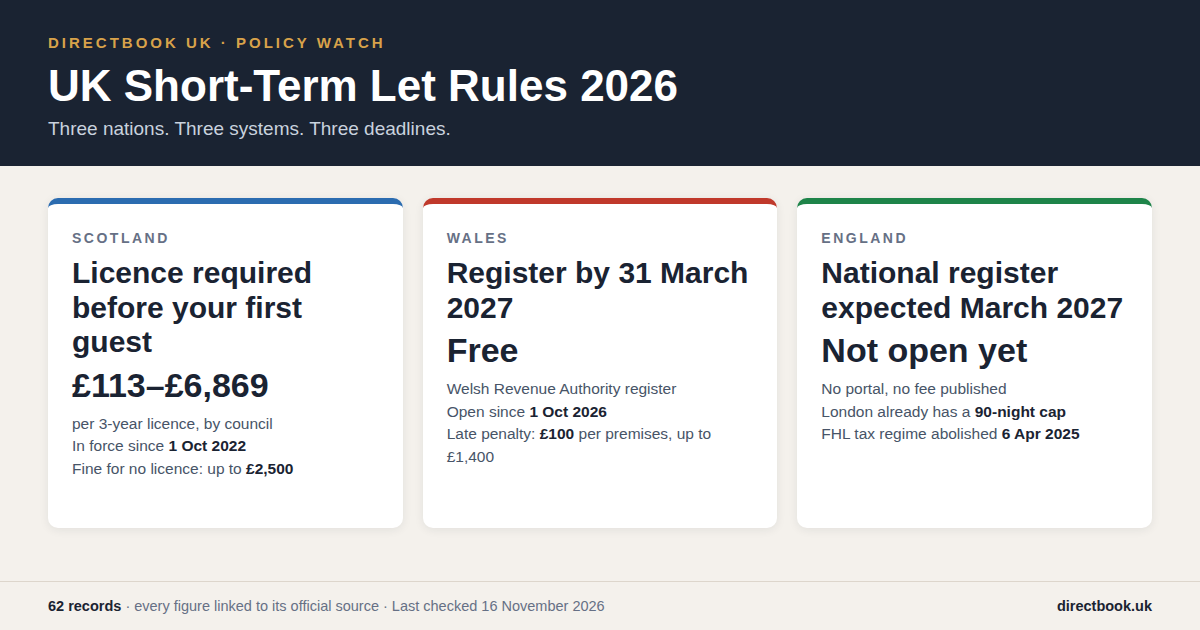
Scotland already requires a licence before you take bookings, with fees from £113 to £6,869 per council. Wales requires free registration with the Welsh Revenue Authority by 31 March 2027. England has no register to join yet — the national scheme is expected in March 2027. This guide compares all three systems from official sources.
How do Scotland, Wales and England compare?
Scotland licences, Wales registers, and England is still waiting — the table below puts the three systems side by side.
| Scotland | Wales | England | |
|---|---|---|---|
| System | Mandatory licensing | Mandatory registration (licensing later) | National registration (not yet open) |
| Status now | In force since 1 Oct 2022 | Registration open since 1 Oct 2026 | Expected March 2027 |
| Key deadline | Licence before first booking | Register by 31 Mar 2027 | None yet |
| Cost | £113–£6,869 per council (3-year licence) | Registration free; licence fee not published | Fee not published |
| Penalty for not complying | Up to £2,500 fine (criminal offence) | £100 per premises, escalating to £1,400 max | Not published |
| Administered by | Your local council | Welsh Revenue Authority (WRA) | Not published |
| Planning control areas | Edinburgh (whole area); Highland — Badenoch & Strathspey ward | Article 4 directions (e.g. Eryri National Park) | Greater London 90-night rule |
If you let in more than one nation, you answer to more than one system. Each section below links the official source for every key date and figure.
Do I need a licence for a short-term let in Scotland?
Yes — you need a licence from your council before taking bookings or guests. Licensing has been mandatory across Scotland since 1 October 2022, under the Civic Government (Scotland) Act 1982 (Licensing of Short-term Lets) Order 2022, and a licence usually lasts 3 years. (gov.scot — Short-term lets: regulation information)
Operating without a licence is a criminal offence: maximum fine £2,500, plus a possible one-year ban on applying. (gov.scot — enforcement)
What does a licence cost?
Every council sets its own fees, usually reviewed every April. The table below gives each council's headline range from its official fees page, last checked 16 November 2026.
| Council | Fee range (3-year licence unless noted) |
|---|---|
| Aberdeen City | £470.40–£3,505.60 |
| Aberdeenshire | £364–£1,006 |
| Angus | £349–£588 |
| Argyll and Bute | £285.30–£1,426.60 |
| City of Edinburgh | £120–£6,869 |
| Clackmannanshire | £314.30–£628.70 |
| Comhairle nan Eilean Siar (Western Isles) | Formula-based: from £189 base + £21 per guest |
| Dumfries and Galloway | £324–£454 |
| Dundee City | £310–£3,100 |
| East Ayrshire | £125–£400 |
| East Dunbartonshire | From £275 per room (home sharing); £495–£594+ (home/secondary letting) |
| East Lothian | Not published (see note) |
| East Renfrewshire | £377–£1,293 |
| Falkirk | £157.50–£504 |
| Fife | £310–£867 |
| Glasgow City | £156–£494 |
| Highland | £320–£610 |
| Inverclyde | £275–£550 |
| Midlothian | £247–£767 |
| Moray | £540 flat |
| North Ayrshire | £150–£480 |
| North Lanarkshire | Not published (see note) |
| Orkney Islands | £275–£583 (non-linked isles £206–£437) |
| Perth and Kinross | £175–£1,600 |
| Renfrewshire | £291–£1,274 |
| Scottish Borders | £417–£537 |
| Shetland Islands | £210–£530 |
| South Ayrshire | £150–£480 |
| South Lanarkshire | £317.86–£953.58 |
| Stirling | £113–£453 |
| West Dunbartonshire | £929 flat |
| West Lothian | £325–£1,000 |
Why two councils are blank. East Lothian and North Lanarkshire publish their full fees only inside downloadable documents we could not read with free tools. Third-party figures are unverified, so we do not print them.
One East Lothian figure is confirmed: its temporary licence (up to 6 weeks) costs £291 (council Cabinet report, 12 May 2026).
Fee-year caveats. Some fees come from older schedules — Edinburgh's page still shows 2025–26, Stirling's shows 1 April 2025 to 31 March 2026. Confirm the current fee on the council's official page.
Where are the control areas?
Only two control areas are in force in Scotland. In one, using a whole dwelling that is not your main home as a short-term let very likely needs planning permission first, and mandatory condition 13 applies. (gov.scot)
- City of Edinburgh — the whole council area, since 5 September 2022 (Scotland's first control area).
- Highland — the Badenoch & Strathspey ward only, since 4 March 2024.
More control areas are proposed but not in force — a proposal is not law until formally designated.
- Highland (Inverness City; Highland Rural): approved by Scottish Ministers on 26 October 2026, proposed start 1 April 2027.
- Perth and Kinross: councillors agreed on 17 June 2026 to propose a control area in Highland Perthshire and northern Eastern Perthshire; awaiting approval.
- Argyll and Bute: consulting on proposed areas in autumn 2026.
Outside control areas, planning permission may still be needed case by case — check with your council's planning team.
For the full Scotland picture, see our Scotland short-term let licence guide.
When must I register a holiday let in Wales?
By 31 March 2027, if your accommodation was open for bookings before 1 April 2027 — and registration is free. The scheme runs under the Visitor Accommodation (Register and Levy) Etc. (Wales) Act 2025, run by the Welsh Revenue Authority (WRA). (GOV.WALES — Registering visitor accommodation: overview)
Who must register?
You must register if all three apply: you take bookings for overnight stays in visitor accommodation in Wales; you are responsible for the accommodation; and your bookings are for 31 nights or less. This covers self-catering lets, B&Bs, guesthouses, hotels, main homes and spare rooms, glamping, hostels and pitches.
After registering you receive a unique registration number. Accommodation first opening on or after 1 April 2027 must register before it opens; updates and deregistration must be made within 30 days of the change. The WRA service opened on 1 October 2026.
What happens if I miss the deadline?
The late penalty is £100 per premises, escalating if you still do not comply. Each address counts as one premises; penalties are payable within 30 days. (GOV.WALES — Failing to register, update details, or deregister)
- £100 per premises for failing to register, update or deregister on time.
- Then £10 per premises per day for up to 30 days, and a further £1,000 if you still have not registered.
- Maximum per premises: £1,400. The WRA may also register you itself, with the same penalties.
Is there a visitor levy?
Not across Wales — each of the 22 Welsh councils decides, after consulting its community, with 12 months' notice; a levy takes effect on 1 April or 1 October. (GOV.WALES — Senedd passes legislation to support the future of tourism in Wales)
- Cardiff is the first and, as of late October 2026, the only council charging it, on stays from 1 April 2027.
- Rates are set Wales-wide: £1.30 per person per night (standard), 75p for shared hostel, bunkhouse, bothy or dormitory rooms and tent pitches. Under-18s are exempt on the lower rate only; stays of 32+ nights pay no levy.
Is licensing coming?
Not yet — the framework exists, but no licence is needed and no application exists. The Development of Tourism and Regulation of Visitor Accommodation (Wales) Act 2026 (Royal Assent 27 April 2026) starts with self-contained self-catering accommodation. (GOV.WALES — Licensing of visitor accommodation in Wales)
- Likely start: 2029 — a stated expectation, not a date fixed in the Act. (Welsh Government News)
- Legal default: March 2030 (4 March 2030 under s.61); Ministers can bring it in earlier or move it back by up to 2 years.
- No licence fee has been published. Media figures (around £75, or £172 a year) are not official pricing. The first charging regulations must go through at least 12 weeks of consultation.
What about planning and business rates?
Wales has three dwellinghouse use classes since the 2022 amendments. Changing between them is generally permitted development, unless an Article 4 direction removes that right. ([High Court judgment [2025] EWHC 437 (Admin)](https://assets.caselaw.nationalarchives.gov.uk/ewhc/admin/2025/437/ewhc_admin_2025_437.pdf))
- C3 — sole or main residence, occupied more than 183 days a year.
- C5 — second home, occupied 183 days or fewer.
- C6 — short-term let, commercially let for 31 days or less.
- Article 4: Gwynedd's direction was quashed by the High Court on 24 September 2025; Eryri National Park Authority has an active direction. ([High Court judgment [2025] EWHC 2395 (Admin)](https://assets.caselaw.nationalarchives.gov.uk/d-6d2d07bf-8ef0-4973-91e9-47ed9ecc9ac8/d-6d2d07bf-8ef0-4973-91e9-47ed9ecc9ac8.pdf))
For business rates, a self-catering property must be available for short-period letting for 252 days or more in the next 12 months, have been available for at least 252 days in the last 12 months, and have been actually let for at least 182 days. (Business Wales — Non-Domestic Rates for Self-Catering Properties in Wales)
- "Short periods" means lets of 28 days or fewer. These thresholds have applied since 1 April 2023 (previously 140/70).
- Missing either test makes the property domestic and liable for council tax — Welsh councils may add a second-home premium of up to 300%.
- Consultation: the Welsh Government consulted (31 July – 23 October 2026) on the 182-day threshold. No response had been published by 16 November 2026, and floated figures (105 or 154 days) are not law. (GOV.WALES — Written statement: consultation on self-catering classification)
For the full Wales picture, see our Wales holiday-let registration guide.
Is the England short-term let register open yet?
No — there is no register to join, no portal, no published fee and no exact start date. GOV.UK guidance (reviewed 2 October 2026) says the mandatory national scheme is "expected to begin in March 2027" — an expectation, not a fixed statutory date. (GOV.UK — Letting out a self-catering holiday home in England: rules and regulations)
The legal basis is section 228 of the Levelling-up and Regeneration Act 2023 (in force 26 December 2023). As of mid-October 2026 no implementing statutory instrument had been published on legislation.gov.uk.
Not published as of 16 November 2026: the fee; the penalty; who will run the scheme; the exemptions; what registration will require; and the re-registration cycle. A figure of around £5,000 in policy documents is not a decided rule and is not adopted here.
What is the 90-night rule in London?
In Greater London, letting residential premises as temporary sleeping accommodation for more than 90 nights in a calendar year is a material change of use needing permission — unless the 90-night exception applies. (Deregulation Act 2015, s.44 — legislation.gov.uk)
- Both conditions must be met: total nights in the same calendar year do not exceed 90; and the provider was liable to pay council tax at the premises for each night.
- The count attaches to the premises, not the operator, and resets on 1 January. "Temporary sleeping accommodation" means stays of fewer than 90 consecutive nights by the same person.
- If either condition fails, planning permission from the London borough is required. Councils also hold a reserve power (s.25B) to disapply the exception for particular premises or areas.
What about planning, rates and tax outside London?
Outside Greater London there is no national night threshold. GOV.UK guidance says your local planning authority decides case by case whether you need planning permission. (GOV.UK)
- C5 use class: not law. A new C5 class was consulted on in 2023 (closed 7 June 2023), but no statutory instrument has been laid; GOV.UK is still analysing feedback. (In Wales, C5 means a second home and C6 is the short-term let class.)
- Business rates: since 1 April 2023, a self-catering property qualifies for business rates at 140 nights available and 70 nights let in a year, with 140+ nights intended next year — a much lower bar than Wales (252/182 days).
- Furnished Holiday Lettings abolished: the FHL tax regime ended on 6 April 2025. From 2025–26, short-term holiday income is taxed under usual residential landlord rules. (Corporation tax: from 1 April 2025.)
For the full England picture, see our England short-term let register guide.
Can I download the rules as open data?
Yes — the full dataset behind this guide is free on GitHub under the MIT licence: uk-short-term-let-regulations-2026. It holds 62 records — 32 Scottish councils, 19 Wales records, 11 England records — each with a source_url to the official page, last checked 16 November 2026.
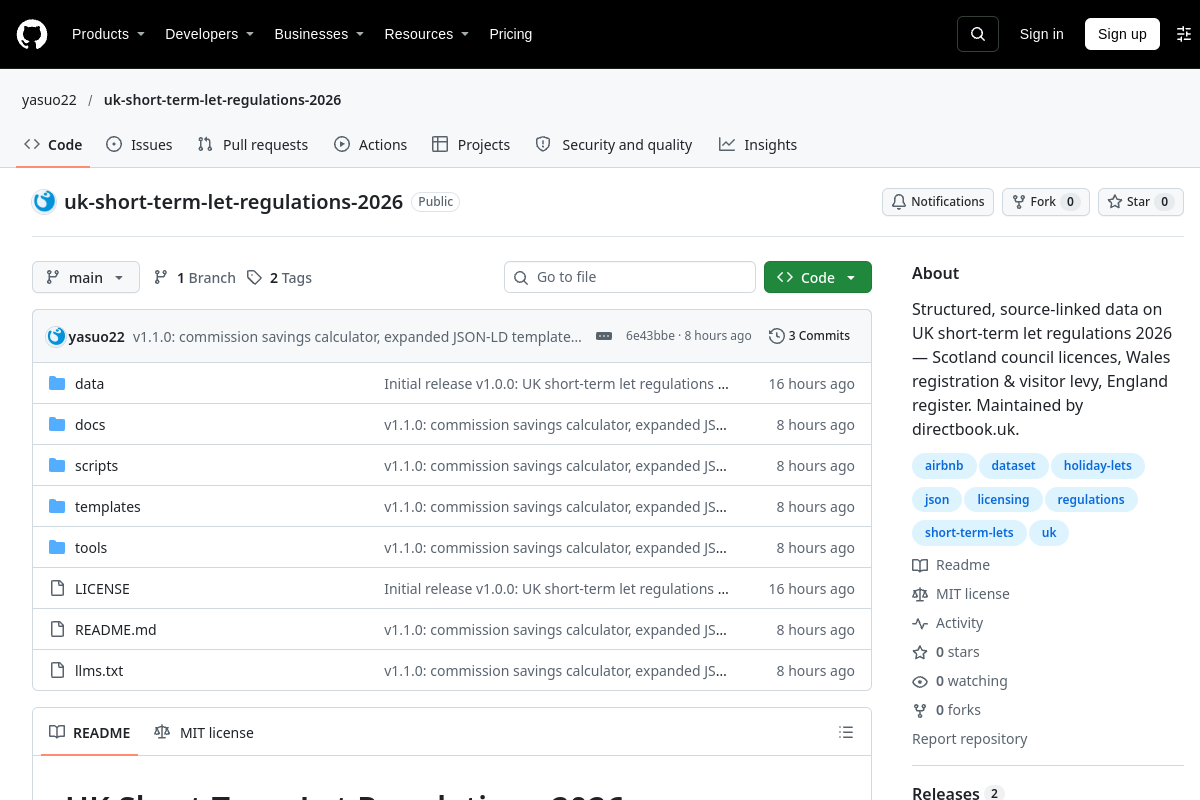
How we handle unverified figures. Where an official number does not exist yet, the dataset records it as not published — see Method and sources below.
One honest limitation: the data is current as of 16 November 2026, and council fees are usually reviewed every April — always confirm the current fee on your council's official page before applying.
Frequently asked questions
Do I need a licence for a short-term let in Scotland?
Yes. Licensing has been mandatory across Scotland since 1 October 2022. You need a licence from your local council before taking bookings or guests. Fees range from £113 to £6,869 for a 3-year licence.
When is the Wales holiday-let registration deadline?
31 March 2027, for accommodation open for bookings before 1 April 2027. Registration with the Welsh Revenue Authority is free. The late penalty is £100 per premises, escalating to a maximum of £1,400.
Is the England short-term let register open yet?
No. GOV.UK guidance (reviewed 2 October 2026) says the mandatory national scheme is expected to begin in March 2027. There is no portal, no published fee and no exact start date.
The bottom line
Scotland already licences, Wales registers by 31 March 2027, and England is still waiting — check which system covers your property before your next booking. Fees and deadlines differ by nation and council; confirm the current figure on the official page linked here. The dataset behind this guide is free under the MIT licence.
Method and sources
Every figure in this guide comes from the open dataset above. The table below lists each primary source, with its date, scope and evidence level.
| Source | Date | Scope | Evidence level |
|---|---|---|---|
| gov.scot — Short-term lets: regulation information | Updated 15 May 2026 | Licensing; enforcement; control areas | Official |
| mygov.scot — Short-term let licences | Checked 16 Nov 2026 | Applying; licence first | Official |
| 32 Scottish councils — official fees pages, schedules and policy statements | Various; some 2025–26 schedules | Licence fees by council | Official, with fee-year caveats |
| GOV.WALES (WRA) — Registering visitor accommodation | Updated 8 Oct 2026 | Registration; deadline; penalties | Official |
| GOV.WALES — Licensing of visitor accommodation in Wales | Updated 8 May 2026 | Licensing framework; 2030 default | Official |
| Welsh Government News — Wales to create new standards for holiday accommodation | 17 Mar 2026 | Licensing expected 2029 | Official |
| GOV.WALES — Senedd passes legislation to support the future of tourism in Wales | Checked 16 Nov 2026 | Levy rates; council choice | Official |
| Business Wales — Non-Domestic Rates for Self-Catering Properties in Wales | Checked 16 Nov 2026 | 252/182-day tests | Official |
| GOV.WALES — Written statement: consultation on self-catering classification | Checked 16 Nov 2026 | 182-day consultation | Official |
| High Court judgments [2025] EWHC 437 and EWHC 2395 (Admin) | 2025 | Use classes; Article 4 | Judgment |
| GOV.UK — Letting out a self-catering holiday home in England | Reviewed 2 Oct 2026 | Register status; legal basis; planning; FHL | Official |
| legislation.gov.uk — Deregulation Act 2015, s.44 | In force 26 May 2015 | London 90-night rule | Legislation |
Not verified / not published (left blank, not guessed):
- England registration fee, penalties, operator, exemptions, requirements, and re-registration cycle.
- Wales licence fee.
- Full licence fees for East Lothian and North Lanarkshire (only in downloadable documents we could not read).
- Fee-year caveats: 9 councils' published fees come from older schedules — confirm the current fee on the council's official page.
- South Ayrshire fees may change: the council is reviewing its policy (consultation closed 12 June 2026).
- West Lothian: the fees schedule uses bedroom bands, not the policy appendix's guest bands — the table follows the appendix.
Next review triggers: England implementing regulations published; Welsh Government response to the 182-day consultation; or a new council fee schedule (usually April).
Show your licence number on your own website
Your licence or registration number is a trust signal worth displaying accurately — but a website cannot substitute for legal compliance. If you are weighing up a direct booking website, see our full guide to UK short-term let regulations, and the cost comparison in our B&B website cost guide.
Try a £9.90 demoQuestions? Call +44 7727 811227 (24/7 AI) · WhatsApp (human) · hello@directbook.uk
Sources: the official pages linked above, and our open dataset (UK Short-Term Let Regulations 2026, release v1.1.0). Last checked 16 November 2026. This page is guidance, not legal, tax or planning advice. Rules, fees and deadlines change, and “not yet published” means the official source has not announced the figure — always confirm with the official source before acting.